Blog icon

China Top 10 4 Inch Flexible Hose Manufacturers

Selecting a 4 flexible hose is not just a matter of matching its diameter. Buyers need to consider working pressure, temperature range, bend radius, reinforcement, and the fluid being carried. A hose that looks suitable on a catalog page may kink behind a pump or wear against a sharp cabinet edge. Small details matter.

This guide examines ten China-based manufacturers and the information buyers can use to compare them. It focuses on practical checks: product specifications, material options, custom-length capability, quality documentation, and communication during sampling. Claims should be confirmed directly with each supplier. A polished website is not proof of consistent production.

A useful engineering maxim is: “A hose is only as dependable as its weakest connection.” No source material or verifiable expert quotation was provided, so this line is presented as a general editorial principle, not as a named expert’s quote. That distinction matters. Supplier rankings can also change with product scope and evidence; this list should be treated as a starting point, not a final verdict. Ask for current datasheets, sample pieces, and clear answers about fittings and operating conditions. Check the details twice. A missed specification can turn a neat installation into a maintenance problem.
China Top 10 4 Inch Flexible Hose Manufacturers

4-Inch Flexible Hose Basics: 101.6 mm Nominal Size and DN100 Context

A 4-inch flexible hose is commonly described by a nominal size of 101.6 mm. The conversion is exact: NIST Special Publication 811 gives 1 inch as 25.4 mm, so four inches equals 101.6 mm. But nominal size is a label, not a promise about the hose’s measured inside diameter.

Not quite.

ISO 6708:1995 defines DN as a nominal-size designation for pipework components. In practice, a 4-inch hose is often associated with DN100, but the two labels do not guarantee identical bore dimensions. Check the product drawing for minimum and maximum inside diameter, then confirm the measurement method and tolerance. This matters when matching a hose to a pump outlet, clamp, or rigid pipe. A small mismatch can create a snagging edge or make assembly difficult. The wording on catalogs can be confusing, and I would not rely on “4 inch” alone. Confirm whether the stated size refers to nominal bore, actual inside diameter, or connection size before ordering.

Key Specifications: Working Pressure, Temperature, Bend Radius, and ISO 1307

When comparing China’s top 10 manufacturers of 4-inch flexible hoses, check operating conditions before comparing prices. A nominal four-inch size does not guarantee an identical inside diameter. Ask for measured dimensions and tolerances. Fit matters. Even a small mismatch can affect clamps, sealing, and flow.

Working pressure should refer to continuous operation, not burst pressure. Confirm that the rating applies at your operating temperature and with the intended fluid or gas. Heat may reduce pressure capacity, while cold can stiffen the hose wall. Request derating data and test documentation. A spec sheet can still leave gaps. Get written confirmation for the exact hose construction.

Check the minimum bend radius against the installation drawing. Follow the supplier’s stated measurement method, such as measuring along the hose centerline. A tight turn near a coupling can kink a large-bore hose. ISO 1307 helps verify hose dimensions and tolerances; it does not qualify pressure or temperature performance. Compare the specified size range with the finished assembly, then check the end fittings separately. Small detail, big consequence. Before approval, inspect sample measurements for ovality, cover damage, or exposed reinforcement. Routing changes after installation can also invalidate the original bend-radius check.

China’s Top 10 Manufacturers: Hose Types, Materials, and Application Sectors

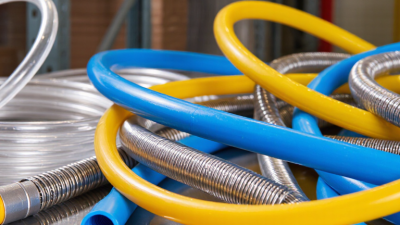
China’s 4-inch flexible hose manufacturers supply several distinct designs: smooth-bore rubber, corrugated metal, thermoplastic, and wire-reinforced PVC or polyurethane. Material selection depends on the conveyed medium, temperature, pressure, and bend radius. Rubber often suits water, air, and abrasive slurries; stainless steel handles heat and movement; thermoplastics can reduce weight in chemical or food-processing lines. Fit matters.

MarketsandMarkets’ Industrial Hose Market report estimated the global market at USD 13.1 billion in 2023 and projected USD 17.0 billion by 2028. That growth reflects demand across manufacturing, construction, mining, agriculture, and oil and gas. For buyers comparing China’s top ten suppliers, the headline material is only a starting point. Check whether the hose is intended for suction, discharge, or both, and ask for pressure ratings, temperature limits, and test documentation. Not interchangeable.

Application details change the specification. A slurry line needs abrasion resistance and secure couplings; a hot-water connection needs suitable temperature ratings and reinforcement. Food-contact service calls for documented material suitability and cleanable construction. A small drawing error can also turn a flexible run into a kinked one. A catalog rating is not a field result. Before ordering, compare sample dimensions and connection details with the actual installation, then verify performance under operating conditions.

4-Inch Flexible Hose: Typical Material Temperature Limits

Indicative upper continuous-use temperatures for common hose materials. Actual limits depend on hose construction, pressure, media, and manufacturer specifications.

Material selection varies by application sector: PVC is commonly used for general-purpose water and air transfer, EPDM for water and many outdoor services, silicone for temperature-sensitive processes, and PTFE for chemically demanding applications. Confirm the rating for the complete 4-inch hose assembly before use.

Quality Testing: ISO 1402 Hydrostatic Tests and ISO 6803 Impulse Tests

China Top 10 4 Inch Flexible Hose Manufacturers

For a four-inch flexible hose, appearance alone cannot confirm pressure reliability. Quality checks should include hydrostatic testing under ISO 1402 and impulse testing under ISO 6803. These methods examine different failure risks. Hydrostatic testing applies controlled internal pressure to assess strength, leakage, and deformation. Test pressure and duration should match the hose specification; they are not universal values. Inspectors should record sample details, pressure readings, and any visible damage. Small leaks matter.

Impulse testing subjects a hose assembly to repeated pressure cycles. It can reveal fatigue around the hose body and end connections that a single pressure test may miss. Test conditions, including pressure range and cycle count, must be defined and documented. A report is useful, but it is not the whole story. Buyers should also ask how samples are selected and whether test equipment is calibrated. A result from one sample may not represent every production batch.

Tips: Check that fittings are included when the application requires assembled-hose testing. Compare reports with the hose’s stated working pressure and service conditions. Keep the records. Also ask about retesting after design or material changes; this detail is easy to overlook.

China Top 10 4 Inch Flexible Hose Manufacturers - Quality Testing: ISO 1402 Hydrostatic Tests and ISO 6803 Impulse Tests

Supplier-neutral evaluation matrix. The entries below describe comparison criteria, not verified results or rankings for specific manufacturers.

No. Evaluation dimension Relevant method or reference What to verify for a 4-inch hose Evidence to request
1 Nominal bore and dimensions Product drawing and purchase specification Confirm the stated 4-inch nominal bore; 4 inches equals 101.6 mm. Check the specified inside-diameter tolerance, outside diameter, and length. Controlled drawing and dimensional inspection records.
2 Hydrostatic proof test ISO 1402 Check that the test pressure, hold time, and acceptance criteria follow the applicable hose specification. ISO 1402 describes the test method; it does not set one universal pressure for every hose. Test report showing specimen identification, pressure, duration, and observations.
3 Burst pressure test ISO 1402 Compare the recorded burst pressure with the minimum required by the product specification. The required value depends on hose construction and intended service. Burst-test record, including failure pressure and failure location where applicable.
4 Pressure-related dimensional change ISO 1402 and product specification Review elongation, expansion, or other dimensional-change results where these are required for the hose type and application. Recorded measurements before and during the specified pressure test.
5 Hydraulic impulse test ISO 6803 Confirm the impulse pressure, waveform, frequency, temperature, and required cycle count against the relevant product specification. ISO 6803 provides a test method, not one universal service-life target. Impulse-test report with test conditions, cycle count, and any leakage or failure observations.
6 Impulse-test configuration ISO 6803 and test plan Verify that the hose is tested in the configuration specified by the method and product requirements. ISO 6803 covers hydraulic-pressure impulse testing without flexing. Test setup description, specimen details, and equipment calibration status.
7 Test specimen and conditioning Applicable ISO method and documented procedure Check specimen preparation, conditioning, test-fluid details, and any required temperature controls for the selected test. Procedure and completed test worksheet identifying the specimen and conditions.
8 Post-test inspection Acceptance criteria in the product specification Inspect for leakage, rupture, visible reinforcement exposure, fitting movement, or other specified defects after testing. Inspection checklist and photographs or recorded observations where required.
9 Test equipment and calibration Laboratory quality procedures and applicable test method Confirm that pressure-measuring and recording equipment is suitable for the test range and has current calibration records. Equipment identification and calibration certificates or status records.
10 Batch traceability and reporting Purchase specification and quality records Ensure test samples can be linked to the production batch and finished hose, with acceptance limits stated before testing. Batch identification, inspection records, and signed test reports.

Note: Test pressures, impulse conditions, cycle counts, and acceptance limits must be selected from the applicable hose standard, design specification, or customer requirement; they should not be assumed to be identical for all 4-inch flexible hoses.

Supplier Comparison: Certifications, Production Capacity, Lead Time, and Service

When comparing China’s top 10 4-inch flexible hose manufacturers, look beyond quoted prices. Check whether certifications cover the exact hose construction, materials, and intended use. Ask for current test reports, traceable batch records, and stated pressure and temperature limits. A certificate alone does not confirm that every batch performs alike.

Production capacity needs practical verification. Request monthly output for your specification, current utilization, and a recent production schedule. A factory may have impressive equipment yet limited capacity for a custom lining or fitting. Lead time should separate sample approval, material sourcing, production, and inspection. Confirm the shipment date in writing. Delays happen. Service matters too: assess response times, technical documentation, replacement-part availability, and how defects are investigated. If possible, review a sample and check its dimensions before placing a large order.

Tips: Send every supplier the same specification sheet. Compare test methods and certificate validity, not just quoted prices. Ask for a realistic delivery window that includes inspection time. Keep one open question in your notes; supplier comparisons are rarely perfectly clean.