Blog icon

2026 Top Fiber Media Converter Types for Global Buyers?

Global buyers entering 2026 need more than a basic product list when selecting a Fiber Media Converter. Network distance, fiber type, port speed, environmental conditions, and management requirements can change the correct choice. A converter used inside a quiet office may fail in a dusty roadside cabinet. Field experience matters. Small details often decide long-term reliability.

This guide examines major Fiber Media Converter types for international projects, including single-mode, multimode, copper-to-fiber, PoE, industrial, managed, and ruggedized models. Each type serves a different operating environment. Single-mode units support longer links between buildings or sites, while multimode models often suit shorter data-center connections. PoE converters can simplify camera and wireless access-point installations, but power budgets need careful checking. Industrial versions may offer wider temperature ranges, stronger housings, and redundant power options.

Technical specifications should be verified against actual deployment conditions, not marketing language alone. Buyers should review wavelength compatibility, transmission distance, connector design, data rates, power input, and network management features. Regional certification and warranty support also deserve attention. They can influence purchasing decisions as much as the initial price.

No comparison is perfect. Product availability changes across markets, and manufacturer claims may require independent verification. A lower-cost model can appear attractive, yet replacement delays may create higher operational costs. This overview therefore combines practical installation considerations with established networking principles. It aims to help distributors, integrators, and end users make clearer decisions, while recognizing that the best option depends on the site, budget, and future expansion plan.
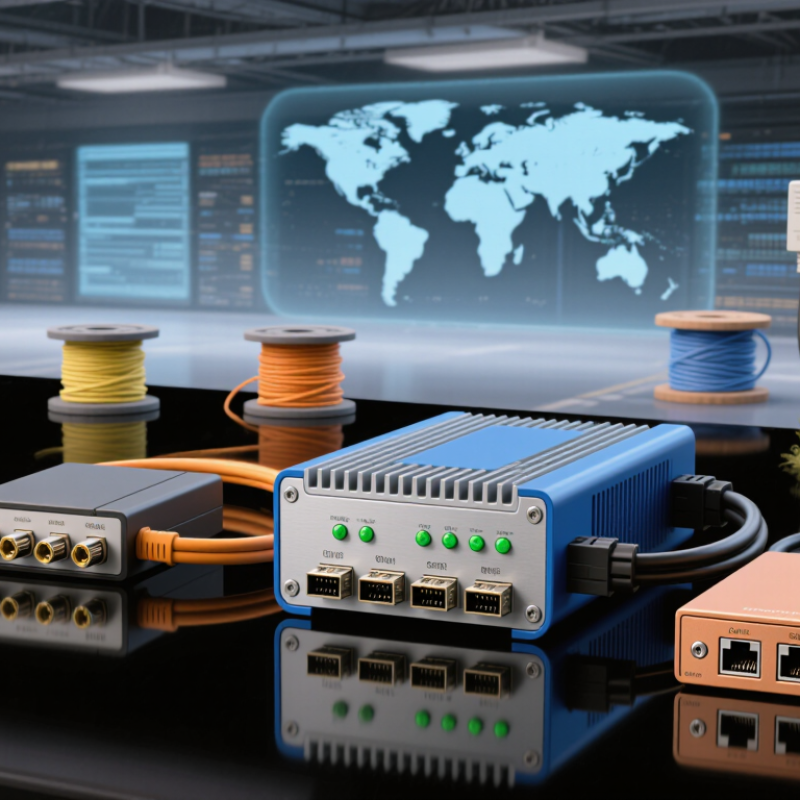
2026 Top Fiber Media Converter Types for Global Buyers?

What Is a Fiber Media Converter and How Does It Work?

A fiber media converter links copper Ethernet equipment to a fiber network. It receives electrical signals through an RJ45 port and changes them into optical pulses. The fiber then carries these pulses across longer distances with lower electromagnetic interference. At the far end, another converter changes the light back into electrical data.

The process sounds simple, but compatibility matters. A converter may support single-mode or multimode fiber, different speeds, and specific transmission wavelengths. Single-mode fiber often suits long-distance links between buildings. Multimode fiber usually fits shorter indoor runs. Duplex models use separate fibers for sending and receiving, while bidirectional models can use one fiber with different wavelengths. Small details matter.

A converter normally works at the physical layer. It does not replace a router or switch. It forwards the signal without making routing decisions. Managed models can report link status, faults, and traffic information. Unmanaged units are easier to deploy.

In real installations, loose connectors cause more trouble than expected. Clean the fiber ends. Check polarity. A link light alone does not prove stable performance. Power quality, heat, grounding, and cable distance also affect reliability. Some buyers focus on maximum speed, then overlook temperature ratings or connector type. That choice can become expensive.

Standards compliance and test records deserve careful review. Specifications are useful, but field conditions are less polite. A poorly matched converter may work today and fail after a temperature change. That uncomfortable possibility should shape the purchasing decision.

2026 Top Fiber Media Converter Types for Global Buyers

What Is a Fiber Media Converter and How Does It Work?

A fiber media converter changes Ethernet signals from copper cabling into optical signals for transmission over fiber, then converts them back at the receiving end. The chart compares common converter configurations by typical maximum Ethernet transmission reach. Actual distance depends on fiber category, optical transceiver specification, connector quality, and network conditions.

Which Fiber Media Converter Types Are Available in 2026?

In 2026, fiber media converters are available in several practical forms. Copper-to-fiber converters connect RJ45 Ethernet devices to optical links. Fiber-to-fiber models join different fiber types, wavelengths, or connector systems. Single-mode versions support long-distance links, while multimode units suit shorter runs inside buildings and campuses. The choice is less glamorous than it sounds.

Unmanaged converters fit simple point-to-point networks. Managed versions add monitoring, alarms, VLAN support, and remote configuration. PoE media converters carry both data and power to compatible cameras, access points, and industrial sensors.

Hardened industrial models use wider temperature ratings and stronger enclosures for factories, roadside cabinets, and transport systems. Available speeds now commonly include 100 Mbps, 1 Gbps, 10 Gbps, and selected 25 Gbps or 100 Gbps applications.

100 Mbps 1 Gbps 10 Gbps 25 Gbps or 100 Gbps

Market demand supports this variety. Grand View Research estimated the global fiber optics market at about US$8.7 billion in 2023, with double-digit growth projected through 2030. The report covers broader fiber infrastructure, not converters alone, so applying its figure directly would be misleading.

IEEE 802.3 standards also define Ethernet rates and physical interfaces, helping buyers compare converter specifications more reliably. In practice, distance, fiber core size, optical budget, latency, and management needs matter more than speed labels. A faster port can still fail when its wavelength or transceiver range is mismatched.

Check the actual link budget.

How Do Copper, Fiber, Wavelength, and Port Options Differ?

Choosing a fiber media converter in 2026 depends on distance, bandwidth, and existing cabling. Copper models suit short runs, often within 100 meters over balanced Ethernet cable. They simplify upgrades in offices and industrial rooms. Fiber models extend links across campuses, factories, and data centers, with better resistance to electromagnetic noise.

The medium matters.

Multimode fiber can reduce equipment cost over shorter data-center links. Single-mode fiber supports much longer distances and tighter loss budgets. Wavelength converters add another choice. A fixed 1310 nm unit may fit a simple point-to-point link. CWDM or DWDM equipment can carry multiple channels over one fiber pair, but requires careful wavelength planning. TeleGeography’s 2024 Global Bandwidth Research Service reported continued double-digit growth in international bandwidth demand, making optical capacity planning less optional.

Port selection is equally practical. SFP ports commonly support 1G links, while SFP+ and SFP28 address 10G and 25G environments. QSFP-based designs can serve 40G or 100G networks, depending on optics and switching equipment. ITU’s Facts and Figures 2024 counted about 5.5 billion internet users, increasing pressure on access and backbone infrastructure. Yet higher speed is not always better. A 100G converter may waste budget on a stable 1G control network. I have seen installations fail because port standards were checked, but connector polarity was not. Small details matter.

How Should Global Buyers Match Converter Types to Network Needs?

2026 Top Fiber Media Converter Types for Global Buyers

How Should Global Buyers Match Converter Types to Network Needs?

Choosing a fiber media converter should begin with the network, not the product label. For a small office, an unmanaged converter can provide simple copper-to-fiber conversion with minimal configuration. It suits short deployment cycles and stable traffic. Larger networks usually need managed converters, especially when administrators require VLAN control, link monitoring, alarms, or remote diagnostics. This difference matters when equipment sits hundreds of kilometers away.

Fiber distance and cable design also guide the decision. Multimode fiber works well across shorter campus links, while single-mode fiber supports longer connections between buildings or sites. PoE converters can power cameras, access points, or field devices through the network cable. Industrial models are better for vibration, dust, wider temperature ranges, and unstable electrical environments. In practice, buyers should verify connector types, data rates, power input, and local certification requirements before ordering. A fast converter still fails if its optical budget is too small.

Tips: Map every link length, fiber type, and endpoint before comparing prices. Leave spare capacity for future traffic. Test compatibility with existing switches. Do not assume “plug and play” means trouble-free. I have seen projects overlook power redundancy and environmental ratings, then replace equipment early. That mistake is avoidable, but specifications alone cannot reveal every site problem. A short pilot test is often more reliable than a large first purchase.

2026 Top Fiber Media Converter Types for Global Buyers? - How Should Global Buyers Match Converter Types to Network Needs?
Converter Type Typical Copper Interface Typical Fiber Interface Common Data Rate Typical Fiber Medium and Reach Best-Fit Network Need Key Selection Checks
Fast Ethernet Copper-to-Fiber Converter 10/100BASE-TX RJ45 100BASE-FX, usually SC or ST; single-mode or multimode 10/100 Mb/s Multimode: typically up to 2 km
Single-mode: commonly 10–20 km, depending on optics and link budget
Legacy access networks, small surveillance links, building-to-building connections, and older industrial devices. Confirm duplex mode, connector type, fiber mode, auto-negotiation behavior, and compatibility with existing 100BASE-FX equipment.
Gigabit Ethernet Copper-to-Fiber Converter 10/100/1000BASE-T RJ45 1000BASE-SX, LX, or BX; LC is common 1 Gb/s Multimode: up to 550 m with suitable OM3/OM4 fiber for 1000BASE-SX
Single-mode: commonly 5–10 km for standard long-reach links
General enterprise access, campus distribution, security systems, and server-room uplinks. Match 1000BASE-SX with multimode fiber and 1000BASE-LX/BX with the correct single-mode or multimode deployment. Check SFP or fixed-port format.
10-Gigabit Ethernet Converter 10GBASE-T RJ45 or SFP+ host interface 10GBASE-SR, LR, ER, or compatible SFP+ optical interface 10 Gb/s 10GBASE-SR: up to 300 m on OM3 and up to 400 m on OM4
10GBASE-LR: approximately 10 km on single-mode fiber
Data-center interconnects, high-capacity campus backbones, storage networks, and aggregation links. Verify the exact 10GbE standard, optical budget, fiber category, SFP+ coding requirements, and switch compatibility.
Single-Mode Long-Distance Converter 10/100/1000BASE-T or 10GbE copper/electrical port Single-mode fiber using duplex or BiDi optics 100 Mb/s1 Gb/s10 Gb/s Typically 10–40 km; specialized optical modules may support longer distances when the link budget and dispersion limits are suitable. Wide-area links, utility networks, remote facilities, municipal infrastructure, and separated campuses. Calculate total loss, connector and splice loss, wavelength, transmit power, receiver sensitivity, and required safety margin. BiDi requires a matched wavelength pair.
Multimode Short-Reach Converter Usually 10/100/1000BASE-T or 10GbE Multimode fiber using SX or SR optics 1 Gb/s10 Gb/s From tens of meters to several hundred meters; 10GbE commonly reaches 300 m on OM3 and 400 m on OM4. In-building wiring, data centers, factory floors, and equipment rooms where existing multimode cabling is available. Identify OM1, OM2, OM3, or OM4 fiber, verify modal bandwidth, and avoid exceeding the distance limit of the selected wavelength and speed.
PoE Fiber Media Converter 10/100/1000BASE-T RJ45 with Power over Ethernet output 100BASE-FX or 1000BASE-X; single-mode or multimode 100 Mb/s1 Gb/s Fiber reach commonly ranges from 550 m on multimode to 10 km or more on single-mode; the copper PoE segment is normally limited to 100 m for standard Ethernet cabling. IP cameras, wireless access points, VoIP phones, access-control readers, and remote sensors. Check IEEE 802.3af, 802.3at, or 802.3bt support, available power budget, PoE class, copper cable category, and whether the unit is powered locally or through a redundant input.
Industrial-Grade Fiber Media Converter 10/100/1000BASE-T; some models include serial or alarm interfaces 100BASE-FX or 1000BASE-X through SFP or fixed optical ports 100 Mb/s1 Gb/s Commonly 2 km on multimode or 10–40 km on single-mode, depending on the installed optical module. Transportation, substations, manufacturing lines, outdoor cabinets, process control, and harsh electromagnetic environments. Review operating temperature, DIN-rail or wall mounting, vibration resistance, surge protection, redundant power inputs, relay alarms, and ingress protection of the enclosure.
Managed Fiber Media Converter 10/100/1000BASE-T or higher-speed Ethernet 100BASE-X, 1000BASE-X, or 10G optical interface 100 Mb/s1 Gb/s10 Gb/s Reach depends on the selected optical interface, commonly from 300–550 m on multimode to 10–40 km on single-mode. Networks requiring remote monitoring, fault isolation, VLAN separation, link alarms, or centralized configuration. Confirm support for SNMP, web or CLI management, VLAN/QinQ, link-fault pass-through, remote loopback, port mirroring, and firmware management.
Unmanaged Plug-and-Play Converter Usually 10/100/1000BASE-T RJ45 Fixed 100BASE-X or 1000BASE-X optical port 100 Mb/s1 Gb/s Typically 550 m on multimode or 10–20 km on single-mode, subject to the optical specification. Simple point-to-point extensions, low-maintenance office links, temporary installations, and cost-sensitive deployments. Check speed and duplex negotiation, link-fault pass-through, power supply voltage, LED indications, and whether the optical side is fixed or interchangeable.
CWDM or WDM Fiber Converter Usually Gigabit Ethernet or 10GbE electrical interface Single-mode fiber using wavelength-division multiplexing optics 1 Gb/s10 Gb/s Often 10–40 km per optical channel; the actual distance depends on wavelength plan, multiplexer loss, fiber attenuation, and optical budget. Increasing capacity over limited fiber pairs, metropolitan networks, campus backbones, and leased-fiber links. Coordinate channel wavelengths, mux/demux compatibility, insertion loss, connector cleanliness, dispersion limits, and available fiber strands.
Redundant-Ring or Link-Protection Converter One or more 10/100/1000BASE-T ports Dual 100BASE-X or 1000BASE-X fiber ports, depending on design 100 Mb/s1 Gb/s Commonly 2 km on multimode or 10–40 km on single-mode for each segment. Industrial rings, traffic control, surveillance backbones, and sites where a single cable break must not interrupt service. Check ring protocol, recovery time, topology limits, interoperability, loop prevention, redundant power, and alarm reporting.

What Standards, Features, and Suppliers Matter When Choosing One?

In 2026, global buyers are comparing more than copper-to-fiber conversion. Common choices include unmanaged gigabit converters, managed units, PoE models, and 10Gbps SFP-based devices. The right type depends on distance, bandwidth, topology, and maintenance access. Single-mode fiber suits long links, while multimode fiber often fits shorter building connections. Check IEEE 802.3 compatibility, including 1000BASE-SX, 1000BASE-LX, 10GBASE-SR, and 10GBASE-LR. The connector and transceiver must match the fiber, wavelength, and link budget.

Details matter. A managed converter can provide VLAN support, link-fault signaling, remote monitoring, and port statistics. These features are useful in a warehouse where one failed link may affect several cameras. Industrial installations may require a wide temperature range, surge protection, redundant power, and DIN-rail mounting. For office networks, those additions can raise costs without improving daily performance. I once saw a project specify 10Gbps hardware while the existing switches supported only 1Gbps. Expensive, but unnecessary.

Supplier quality deserves equal attention. Request complete datasheets, optical test results, firmware policies, warranty terms, and replacement procedures. Reliable suppliers explain interoperability limits instead of promising universal compatibility. Ask for sample testing with your actual switches and fiber reels. Verify production traceability and relevant regional certifications before ordering. Do not judge by enclosure appearance alone. That shortcut fails. A lower-cost unit may work perfectly, yet weak documentation can make troubleshooting slow and uncertain.