


Blog 
Which Is the Best Safety Guard Gate Manufacturer in China?
Choosing the best Safety Guard Gate manufacturer in China is not a logo contest. It is a decision about how people, machines, and access points interact every shift. A gate may look simple on a catalog page. On a factory floor, hinge alignment, latch engagement, mesh spacing, and switch placement matter. So does its behavior after repeated opening, vibration, cleaning, and maintenance. James Reason, a human-factors and safety expert, wrote, “We cannot change the human condition, but we can change the conditions under which humans work.” That principle applies here: effective guarding should make safe actions clear and practical, not merely match a drawing.
This guide compares manufacturers through evidence buyers can verify: design support, material and finish details, documented testing, customization controls, lead times, spare-part availability, and after-sales response. Ask for drawings, product photos, inspection records, and clear explanations of interlocking options. Check that product claims suit the intended machine and its risk assessment. Small details count. A loose hinge tells a story. A polished brochure does not. Price matters, but a low quote may come with limited documentation or slow replacement support. No single supplier is best for every plant; layout, duty cycle, and maintenance skills change the answer. We may still miss details from afar. Treat this comparison as a starting point, then review samples and technical documents before ordering. The strongest partner is one whose product, records, and service remain consistent after installation.
What Is a Safety Guard Gate and Where Is It Used?
Which Is the Best Safety Guard Gate Manufacturer in China?
What Is a Safety Guard Gate and Where Is It Used?
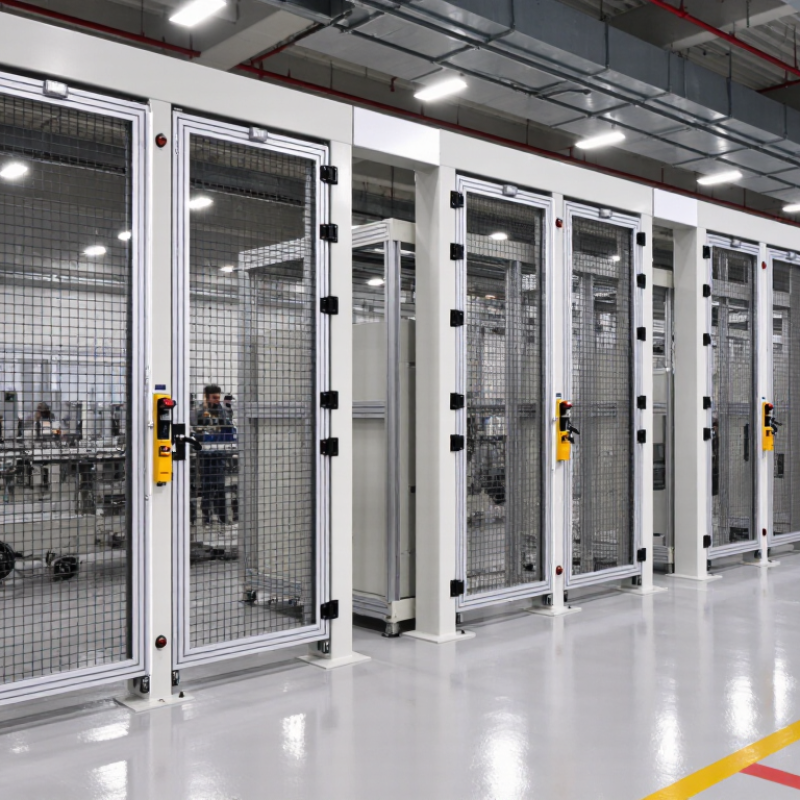
A safety guard gate is a movable barrier fitted into a protective boundary. It lets people enter a work area while helping keep them away from hazards. Unlike a fixed fence panel, it opens for tasks such as loading, cleaning, or maintenance. Some gates include an interlock that stops machinery when the gate opens. Others rely on physical separation and controlled access. The right choice depends on the actual risk.
You may see guard gates around conveyor lines, robotic cells, presses, and automated production equipment. They are also used at warehouse platforms and mezzanine openings, where an unprotected edge creates a fall risk. A gate near a conveyor should not swing into the product path. At a platform, the opening should stay protected during loading. Small details matter.
A practical gate should close reliably, latch securely, and suit the space around it. Check the opening width, hinge direction, visibility, and how often workers pass through. A self-closing design can help, but it is not foolproof. Dust, impact, or a misaligned latch can affect operation. Site-specific assessment and regular inspection matter as much as the gate itself. A careful manufacturer should ask about these conditions before recommending a design.
Which Is the Best Safety Guard Gate Manufacturer in China? - What Is a Safety Guard Gate and Where Is It Used?
| Category | Key Information | Typical Use or Application | What to Check When Selecting a Supplier |
|---|---|---|---|
| What a safety guard gate is | A movable section of a machine guard that provides controlled access to a hazardous area. It is commonly used as part of a perimeter guarding system. | Access points around machinery, production cells, automated equipment, and robot work areas. | Confirm that the gate integrates with the overall machine risk assessment and guarding layout. |
| Hinged swing gate | A gate that opens around hinges. It may open inward or outward, depending on the layout and risk assessment. | Machine enclosures and access points where there is enough space for the gate to swing. | Check opening direction, hinge strength, clearances, latch arrangement, and whether access needs to be monitored by an interlocking device. |
| Sliding gate | A gate that moves horizontally along a track rather than swinging into the surrounding area. | Installations with limited swing clearance or access openings suited to a sliding arrangement. | Review track protection, operating force, end stops, resistance to misalignment, and the effect of dirt or debris on movement. |
| Vertical lift gate | A gate that travels vertically to open or close. Its movement and supporting arrangement must be suitable for the installation. | Applications where horizontal space is limited and the machine layout permits vertical travel. | Assess movement hazards, secure support, prevention of unintended falling, and safe access during maintenance. |
| Interlocked access gate | A movable guard fitted with an interlocking device. Depending on the safety design, opening the gate can initiate a stop function or prevent hazardous operation. | Areas where people need access to hazards that cannot be adequately controlled by a fixed guard alone. | Check the required safety function, device suitability, resistance to foreseeable bypass, and integration with the machine control system. |
| Common application areas | Safety guard gates are used wherever a guarded area needs an access opening for operation, inspection, cleaning, or maintenance. | Manufacturing lines, packaging equipment, material-handling systems, robotic cells, and machine enclosures. | Make sure the gate and surrounding guards suit the hazards, access frequency, work process, and site environment. |
| Guard construction | Frames and infill can be made from materials such as steel mesh, sheet metal, or other suitable materials. The appropriate choice depends on the hazards and installation conditions. | Indoor or outdoor machine guarding and industrial access points. | Consider strength, corrosion resistance, visibility, cleanability, impact exposure, and compatibility with adjacent guard panels. |
| Safety distances and openings | Guard height, openings, and distance from hazards should be selected to prevent access to danger zones, based on the relevant risk assessment and applicable requirements. | All installations where a person could reach through, over, under, or around a guard. | Ask for documented design calculations or drawings where needed; do not rely on a single standard dimension for every machine. |
| Standards and design references | Relevant international references can include ISO 14120 for guards, ISO 14119 for interlocking devices associated with guards, ISO 13857 for safety distances, and ISO 13849-1 for safety-related parts of control systems. | Machine-guard design, interlocking selection, access-distance assessment, and safety-control design. | Verify the current applicable editions, local legal requirements, and whether the supplier can provide information supporting the intended design. |
| Installation and maintenance | A suitable gate should be installed, aligned, inspected, and maintained in accordance with its design and the machine’s safety procedures. | Commissioning, routine inspection, cleaning, and repair of guarded machinery. | Check installation instructions, replacement-part availability, inspection guidance, and support for commissioning and troubleshooting. |
| How to evaluate a manufacturer | Compare the supplier’s engineering capability, product documentation, customization process, quality controls, and delivery and service arrangements. | Shortlisting suppliers for a new machine, factory upgrade, or replacement guarding project. | Request drawings, material details, relevant test or inspection records, lead-time information, warranty terms, and references for comparable applications. |
Important: The appropriate guard gate depends on the machine, hazards, access needs, and applicable regulations. A competent risk assessment and system-level safety design are necessary; a gate alone does not guarantee machine safety.