How to Choose a Hybrid Grid Tie Inverter in 2026?
Choosing a Hybrid Grid Tie Inverter in 2026 is no longer a simple comparison of wattage and price. Homeowners and installers must examine battery compatibility, grid behavior, backup performance, and long-term service support. A unit may look impressive on a product page, yet struggle when rooftop solar production changes rapidly or the battery reaches a low state of charge.
Energy systems expert Amory Lovins is widely quoted as saying, “The cheapest energy is the energy you don’t use.” That principle fits inverter selection surprisingly well. A highly efficient Hybrid Grid Tie Inverter can reduce conversion losses during ordinary household cycles, especially when solar power runs a heat pump, refrigerator, or evening lighting. Still, efficiency figures can be incomplete. They may not reflect standby consumption, partial-load operation, or real battery charging conditions.
The right choice depends on the whole system. Check continuous and surge output, MPPT voltage range, battery chemistry support, communication protocols, and islanding protection. Confirm whether the inverter can provide backup power without uncomfortable delays. Ask who will handle firmware updates and warranty repairs five years later. That part is often overlooked.
A neat checklist can still mislead. Roof shading, local weather, battery placement, and household habits change the result. My own practical view is cautious: the most expensive inverter is not automatically the safest, and the cheapest one may become costly after one failed summer. This guide explains how to compare specifications, installation requirements, monitoring tools, and service quality before making a defensible 2026 decision.
What Is a Hybrid Grid-Tie Inverter and How Does It Work?
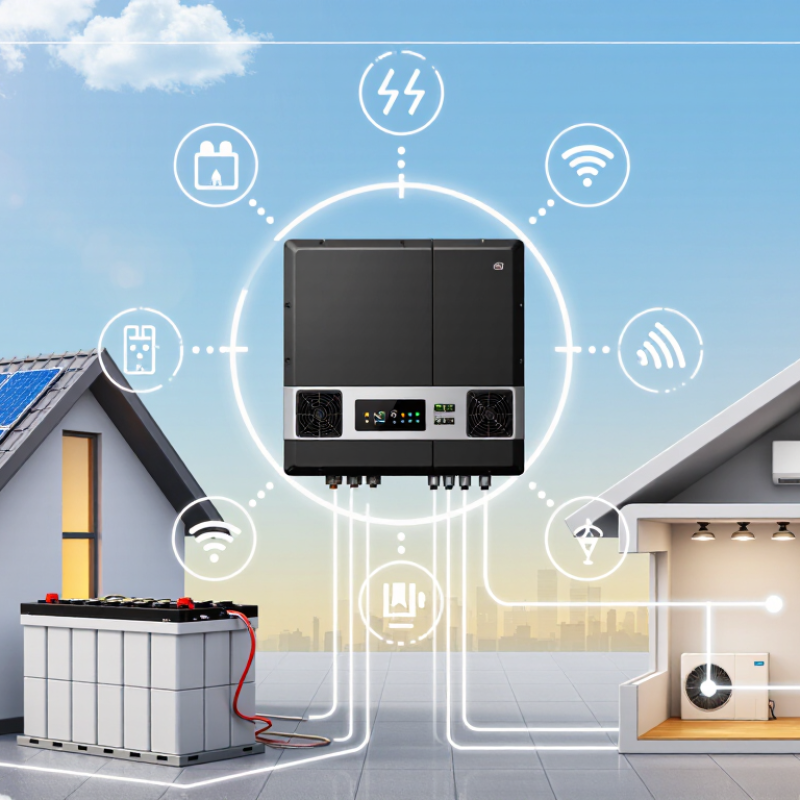
A hybrid grid-tie inverter connects solar panels, batteries, household loads, and the utility grid. Unlike a basic grid-tie inverter, it can manage stored energy during changing conditions. During daylight, solar power first supplies household appliances. Extra energy charges the battery or flows to the grid, depending on the settings. Its MPPT channels adjust panel voltage for better production. Power flow changes constantly. At night, the battery can reduce grid purchases. If the grid fails, an anti-islanding function disconnects the home from utility lines. Backup circuits still require suitable transfer equipment and local approval.
Choosing one in 2026 requires more than comparing advertised efficiency. Check continuous output, surge capacity, battery voltage range, and maximum charging current. A refrigerator may start with a sharp power surge. Round-trip efficiency also affects real savings. Look for export control, time-of-use scheduling, and clear monitoring data. In practical installations, inaccurate consumption data can make an intelligent system behave poorly. A large screen is not enough.
Safety certification and local grid requirements deserve careful checking. Installers should verify grounding, protection devices, cable sizing, and battery compatibility before commissioning. No inverter fits every roof or household. A cloudy week may expose an undersized battery quickly. Oversizing storage can also waste money when daily usage is low. I sometimes prefer a simpler system because fewer settings mean fewer mistakes. Still, the best choice depends on load patterns, outage needs, solar capacity, and future expansion plans. The numbers can disappoint.
How to Choose a Hybrid Grid-Tie Inverter in 2026?
What Is a Hybrid Grid-Tie Inverter and How Does It Work?
A hybrid grid-tie inverter manages electricity from solar panels, household loads, batteries, and the utility grid. The representative 24-hour profile below shows how solar generation can supply daytime loads, charge a battery, and reduce grid imports during evening demand.
How to read the chart: Solar output rises during daylight hours, while household demand continues throughout the day. A suitable hybrid inverter should provide enough AC power for peak loads, support the required battery voltage and capacity, and include grid-interactive functions such as export control and backup power switching.
How Do You Match an Inverter to Your Solar System?
Choosing a hybrid grid-tie inverter begins with the array, not the brochure. Record module count, cold-weather Voc, operating Vmp, and expected peak current. Keep array voltage inside the inverter’s MPPT window. Verify maximum DC voltage at the site’s lowest temperature. A cold morning can push voltage higher than a sunny afternoon. IEA PVPS Trends in Photovoltaic Applications 2024 reports more than 440 GW of PV added globally in 2023. That scale hides local differences.
Match inverter power to realistic production, not the panel total alone. A modest DC oversize can improve morning and winter yield, but excessive clipping wastes capacity. Check the recommended DC/AC ratio, MPPT count, and current limit for each string. Then match the battery’s usable energy, continuous power, chemistry requirements, and communication protocol. The battery must support the loads you actually run. IEA’s Batteries and Secure Energy Transitions report says power-sector battery additions rose about 130% in 2023. Storage is growing fast. Yet a larger battery does not automatically provide longer backup.
Grid rules decide the final fit. Confirm single-phase or three-phase service, export limits, anti-islanding certification, and backup neutral switching. Ask whether backup circuits need whole-home capacity or only refrigeration, lighting, and internet. Measure morning shade and evening demand before selecting MPPT inputs. Real installations are messier than calculators. Field audits often reveal underestimated standby losses on lightly loaded systems. Recheck assumptions with local irradiance data and utility connection requirements. That extra hour can prevent an expensive redesign.
How to Choose a Hybrid Grid Tie Inverter in 2026? - How Do You Match an Inverter to Your Solar System?
| Solar System Profile | PV Array Size | Typical Inverter AC Rating | Recommended Battery Range | Battery Voltage | MPPT Requirement | Grid Configuration | Backup Output Guidance | Best-Fit Application |
| Small essential-load system | 2–4 kWp | 2–3 kW | 5–10 kWh | 48 V class | At least 2 MPPT inputs when roof orientations differ | Single-phase | Prioritize lighting, refrigeration, communications and small appliances; avoid electric heating and large motors. | Compact homes, apartments and essential-load backup |
| Average residential system | 4–8 kWp | 3–6 kW | 8–16 kWh | 48 V class or high-voltage battery, according to inverter compatibility | 2–3 MPPT inputs; verify operating-voltage and maximum-current limits | Single-phase | Can support typical household circuits; check the inverter's continuous and surge ratings for pumps and compressors. | Most grid-connected homes with evening energy shifting |
| Large residential system | 8–15 kWp | 6–10 kW | 15–30 kWh | High-voltage battery is often preferred for higher power levels | 3–4 MPPT inputs for multiple roof planes or partial shading | Single-phase or three-phase, subject to local service | Separate backup and non-backup loads; confirm whether whole-home backup is permitted by the local electrical design. | High-consumption homes, electric vehicles and heat-pump loads |
| Three-phase household system | 8–20 kWp | 8–15 kW | 15–40 kWh | Usually high-voltage, depending on the approved battery platform | At least 2 MPPT inputs; use more when array strings have different orientations | Three-phase | Check phase-balancing limits, motor-starting capability and whether backup power is available on all phases. | Larger homes, workshops and properties with three-phase loads |
| Small commercial system | 15–50 kWp | 12–40 kW | 30–100 kWh | High-voltage battery systems are commonly used | Multiple MPPT channels; string current must remain below the inverter input limit | Three-phase | Size backup capacity around critical refrigeration, networking, security and production loads rather than total connected load. | Retail premises, offices, farms and light commercial facilities |
| High self-consumption system | Any size; commonly 5–20 kWp | Usually selected near the site's maximum continuous demand | Battery energy commonly sized for 3–8 hours of the targeted evening load | Must match the inverter's approved battery voltage range | Match MPPT count to string layout, roof orientation and shading conditions | Single-phase or three-phase | Use load-management controls and time-of-use settings; backup power is optional and may require a separate protected-load panel. | Reducing grid purchases and increasing solar energy use on site |
| Limited-grid or outage-prone site | 4–20 kWp | Based on critical-load demand plus motor-starting surge | 10–60 kWh | 48 V class for smaller systems; high-voltage options for larger systems | Choose enough MPPT capacity for seasonal and multi-directional arrays | Single-phase or three-phase | Verify black-start capability, transfer time, generator compatibility and continuous backup output. | Remote homes, medical-support loads and reliability-focused installations |
What Safety, Efficiency, and Compliance Standards Matter in 2026?
Choosing a hybrid grid-tie inverter in 2026 requires more than comparing rated power and display features. Safety certification should match the installation country and grid operator. Check IEC 62109-1 and IEC 62109-2 for inverter safety requirements. IEC 62116 testing also matters because anti-islanding protection must disconnect the system during grid loss. In North America, IEEE 1547 and the applicable UL 1741 requirements may apply. In Europe, EN 50549 is often relevant. Local rules still decide the final connection.
Efficiency should be measured under realistic operating conditions, not only at the best laboratory point. Review maximum and European efficiency values, standby consumption, thermal derating, and battery charging losses. IEC 61683 provides a useful reference for photovoltaic inverter efficiency measurements. Ask for test conditions and complete performance curves. Small numbers matter. A two-percent loss can become noticeable across years of daily cycling. Heat matters too. An inverter mounted in direct afternoon sun may reduce output earlier than expected.
Compliance also includes electromagnetic compatibility, communication security, and battery safety. Check applicable IEC 61000 requirements, battery certifications, firmware update controls, and event logs. The inverter should record faults clearly without exposing unnecessary personal data. Installer experience is valuable here. I have seen impressive datasheets fail to explain cold-start behavior or backup transfer time. That omission should make buyers cautious. No specification sheet replaces an independent certificate, a grid approval document, and a site-specific inspection.
How Can You Evaluate Installation Costs, Warranty, and Long-Term Value?
Choosing a hybrid grid tie inverter in 2026 requires more than comparing purchase prices. Installation costs often decide the real outcome. Request itemized quotes for labor, permits, wiring, breakers, mounting, commissioning, and battery integration. A technically cheaper inverter may require panel upgrades or longer cable runs. Those hidden details can change the budget quickly.
Warranty terms deserve careful reading. Check the coverage period, labor inclusions, replacement process, and exclusions for heat, poor ventilation, or unauthorized repairs. Ask how warranty claims are handled in your region. A ten-year warranty sounds strong, but delayed shipping can leave a household without backup power. Service records, installer training, and accessible technical support also indicate reliability. These details are less exciting than efficiency ratings, but they matter during faults.
Tips: Compare total ownership cost over ten years, not only the invoice. Include expected maintenance, monitoring fees, battery expansion, and possible replacement labor. Check efficiency at partial loads, because systems rarely operate at full capacity all day. Leave space for ventilation. Confirm software updates and grid-code compliance before signing. Even careful estimates can miss local electrical work. I would keep a contingency fund of 10–15 percent. That may feel excessive, yet real projects often reveal small surprises. A flexible inverter can preserve long-term value, but only if its expansion limits match your future energy needs.


