Blog icon

Top 10 Types of Watering Hoses for Every Need

Choosing the right hose is less simple than grabbing the brightest coil from a garden shelf. Different watering hoses manage pressure, storage, temperature, and daily handling in very different ways. A lightweight expandable hose may suit a balcony planter, while a heavy-duty rubber hose can better support long garden runs and frequent use. The correct choice depends on distance, water pressure, fittings, sunlight, and the user’s physical comfort.

Reliable water management makes this decision more important. The U.S. Environmental Protection Agency’s WaterSense program reports that outdoor water use represents nearly 30% of household consumption in the United States. It also notes that inefficient irrigation can waste significant water through evaporation, runoff, and overspray. A poorly matched hose may add unnecessary waste, especially when leaks appear around worn washers or loose connectors. Small details matter.

This guide examines ten common types of watering hoses, including soaker, expandable, flat, coil, rubber, reinforced PVC, and drinking-water-safe models. Each type has practical strengths and limitations. A soaker hose can deliver water close to plant roots, but it may clog in poor-quality water. An expandable hose stores easily, yet its fabric cover can suffer from abrasion. These categories sometimes overlap. That is worth remembering.

The comparisons draw on EPA WaterSense guidance, U.S. Geological Survey water-use research, and established irrigation-industry practices. We focus on real handling, connection reliability, durability, and sensible water use. Expect useful distinctions, not perfect promises.
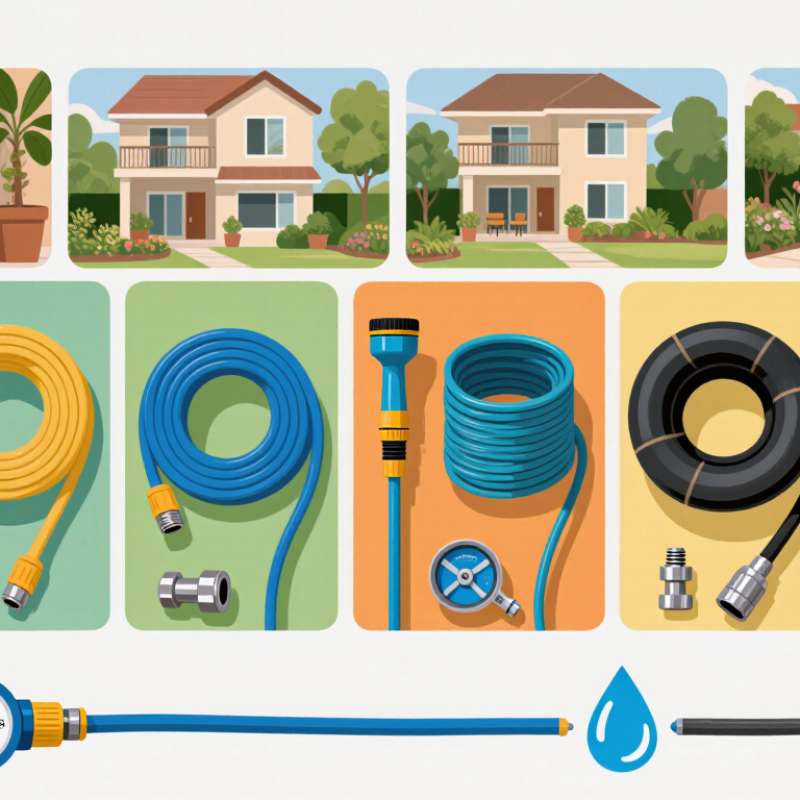
Top 10 Types of Watering Hoses for Every Need

Rubber and Vinyl Hoses for Everyday Garden Watering

Among the top ten types of watering hoses, rubber and vinyl models remain practical choices for everyday garden work.

Rubber hoses usually feel heavier, but they resist heat, abrasion, and repeated bending better. Their flexible walls make it easier to reach flower beds without sharp kinks. Vinyl hoses are lighter and often less expensive. They suit balcony plants, small lawns, and occasional cleaning tasks. However, thin vinyl can twist when left in strong sunlight. My first choice was not always right.

A reliable selection starts with your garden’s actual conditions. Measure the distance from the tap to the farthest planting area. A hose that is too short encourages stretching and weakens the fittings. Check the hose diameter, expected water pressure, and connection quality. For frequent watering, choose reinforced rubber or thick-wall vinyl. For light seasonal use, standard vinyl may be sufficient.

Tips: Store the hose loosely in shade after use. Drain standing water before winter storage. Avoid dragging it across sharp stones or hot paving. Inspect small cracks near the ends each month. A simple repair may work, but damaged sections can fail suddenly. I sometimes overlook storage, and that mistake shortens hose life. A soft spray nozzle also helps protect seedlings and reduce soil erosion around roots.

Expandable and Coil Hoses for Compact Storage and Easy Handling

Top 10 Types of Watering Hoses for Every Need

Among the ten common hose types, expandable and coil hoses are especially useful where storage space is limited. An expandable hose grows when water enters, then shrinks after draining. It can fit inside a small garden box or hang beside a balcony door. A coil hose keeps its spring-like shape, reducing loose loops across walkways. Both designs feel lighter than traditional hoses, which helps when watering hanging baskets or carrying water around a patio.

In my experience, expandable hoses are easiest to handle on short watering jobs. However, they should not remain pressurized after use. Sharp gravel, hot pavement, and dragging around corners may damage the outer layer. Coil hoses resist tangling better, but their reach can feel restrictive near large flower beds. I once chose a coil hose for a narrow courtyard and underestimated the distance. That mistake made every far corner awkward to reach.

Tips: Check the stated pressure rating before connecting a spray nozzle. Drain the hose fully, then store it away from direct sunlight. Inspect connectors for cracks each season. For expandable models, avoid pulling hard when the hose is empty. For coil models, guide the coils gently instead of stretching them flat. A small wall hook can prevent kinks and keep wet surfaces off the floor. These details seem minor, but they often decide whether compact storage remains genuinely convenient.

Soaker and Drip Hoses for Targeted Plant Irrigation

Soaker and Drip Hoses for Targeted Plant Irrigation

Among the top watering hose types, soaker and drip hoses offer the most controlled irrigation. A soaker hose releases water through tiny pores along its length. It wets the soil slowly and evenly around vegetable beds, shrubs, and young trees. A drip hose uses small emitters to deliver water at selected points. This design suits containers, raised beds, and plants with different moisture needs.

I have used soaker hoses beneath mulch during hot summers. The soil stayed damp, while the leaves remained dry. That reduced splashing and helped limit some fungal problems. I once placed the hose too far from the root zone. The surface looked wet, but deeper roots stayed thirsty. That mistake taught me to check the soil by hand, not judge moisture by appearance.

Lay the hose on level ground whenever possible. Pressure changes can cause uneven flow on slopes. Use a filter when the water contains visible sediment. Flush the line before storing it. Drip systems also need careful spacing, because roots do not always grow directly beneath each emitter. A timer can improve consistency, but it cannot correct poor placement. Check the first and last outlets after installation. The final outlet may receive less water, especially with long runs or weak pressure. Keep connections tight, though occasional leaks still happen. Personally, I inspect them after the first watering rather than trusting a perfect setup.

Flat and Heavy-Duty Hoses for Large or Demanding Jobs

Flat hoses suit large areas where storage space matters. They lie flat when empty and roll into a compact bundle. This makes them useful for irrigation, drainage, and emergency water transfer. On a long driveway, a flat hose can cover distance without forming bulky coils. The trade-off is important. They usually need a steady water flow and careful handling around sharp gravel. Empty them completely after use. A partially filled flat hose becomes awkward and surprisingly heavy.

Heavy-duty hoses are better for construction sites, farms, and frequent commercial watering. Look for reinforced walls, abrasion resistance, and a pressure rating above your normal operating pressure. Strong couplings matter just as much as the hose material. I have seen a durable hose fail because its connector cracked under repeated dragging. That mistake was avoidable. Check fittings regularly.

A practical setup also needs strain relief near the tap. Do not pull the hose by its nozzle. Use a reel or wide support when moving it across concrete. Heavy hoses resist kinks, but they are not immune. Store them away from direct sunlight and freezing temperatures when possible. I once left a hose partly exposed through winter, and its outer layer became stiff. It still worked, but not confidently. For demanding jobs, inspect the hose before every shift, especially near bends, couplings, and worn sections.

Top 10 Types of Watering Hoses for Every Need - Flat and Heavy-Duty Hoses for Large or Demanding Jobs

Type of Hose Typical Construction Common Inside Diameter Typical Length Options Typical Working Pressure Best Use Main Advantages Important Limitations
Flat Hose Flexible PVC or coated fabric that lies flat when empty 1/2–2 inches 25–100 feet Usually 60–150 psi, depending on construction Large gardens, drainage, irrigation transfer, and easy storage Lightweight, compact when drained, and simple to roll or store Can kink easily and generally needs water pressure to keep its full shape
Heavy-Duty Rubber Hose Thick synthetic rubber, often with textile reinforcement 5/8–3/4 inch 25–100 feet Typically 150–300 psi Frequent watering, landscaping, workshops, and demanding outdoor work Resists abrasion, temperature changes, crushing, and repeated use Heavier and less convenient to carry than lightweight hose types
Reinforced PVC Hose Flexible PVC with embedded polyester or textile reinforcement 1/2–1 inch 25–100 feet Commonly 100–250 psi General garden watering and moderate-duty utility work Good balance of flexibility, strength, weight, and cost Can become stiff in cold weather and may crack if stored in direct sunlight for long periods
Expandable Hose Elastic inner tube with a woven textile outer jacket Approximately 1/4–1/2 inch when expanded, depending on design 25–100 feet expanded Often 50–100 psi Small yards, balconies, patios, and users needing low storage space Lightweight, compact after use, and easy to carry More vulnerable to punctures, abrasion, sharp edges, and improper storage while pressurized
Soaker Hose Porous recycled rubber or porous PVC that releases water along its length 1/2–5/8 inch 25–100 feet Best operated at low pressure, commonly 10–25 psi Vegetable beds, flower borders, shrubs, and water-efficient irrigation Delivers water slowly at soil level and helps reduce leaf wetting and evaporation Requires relatively even placement and may clog when used with unfiltered water
Coiled Hose Memory-form polyurethane, rubber, or flexible PVC tubing 3/8–1/2 inch 15–50 feet extended Usually 50–100 psi Small patios, decks, balconies, and compact utility areas Retracts automatically and reduces loose hose loops on the ground Limited reach and flow compared with larger-diameter straight hoses
Lightweight Fabric-Covered Hose Thin inner tube protected by a woven polyester or nylon jacket 1/2–5/8 inch 25–75 feet Commonly 50–150 psi Routine residential watering and users who prefer easy handling Light to carry, flexible, and less bulky than many traditional hoses The fabric cover can retain moisture and may be harder to clean after muddy use
Hot-Water Utility Hose Temperature-resistant rubber or thermoplastic with reinforced layers 5/8–3/4 inch 25–100 feet Often 150–300 psi, subject to temperature rating Cleaning equipment, washing areas, greenhouses, and approved warm-water applications Designed to tolerate higher temperatures than ordinary garden hoses Must be selected by its stated temperature rating; hot water can reduce pressure capacity
Drinking-Water-Safe Hose Materials formulated for potable-water contact, commonly food-grade polymers or rubber 1/2–5/8 inch 25–50 feet Typically 100–160 psi Filling drinking-water tanks, recreational vehicles, boats, and potable-water containers Designed to minimize taste, odor, and material transfer when properly certified Certification and temperature limits must be checked before use with drinking water
Micro-Irrigation Supply Tubing Small-diameter polyethylene tubing used with emitters and distribution fittings 1/4–1/2 inch outside diameter, depending on system 50–500 feet Usually 20–60 psi Container plants, raised beds, nurseries, and targeted landscape irrigation Supports precise water delivery and can reduce runoff when correctly designed Needs compatible connectors, filtration, pressure regulation, and protection from damage
Specifications are representative ranges rather than universal ratings. Actual pressure, temperature tolerance, dimensions, and service life depend on the hose material, reinforcement, fittings, and manufacturer’s instructions.

Sprinkler and Drinking-Water-Safe Hoses for Specialized Uses

A garden hose is not automatically suitable for every task. For lawns, a sprinkler hose spreads water through small openings along its length. It works well beneath flower beds, vegetable rows, and newly seeded ground. I have found that gentle coverage prevents soil from washing away. Still, pressure matters. Too much pressure can create uneven sprays or loosen fittings. Check the connection before leaving it unattended. Small leaks become large puddles.

Drinking-water-safe hoses need stricter material choices than ordinary garden hoses. Look for clear labeling that confirms suitability for potable water, plus independently verified safety certification where available. Avoid hoses with a strong plastic smell, especially when water will touch them for several minutes. Flush a new hose thoroughly before use. Let the water run until it feels cool and tastes neutral. That step is easy to skip. It should not be. Use a dedicated hose for drinking water, not one shared with fertilizers, cleaners, or dirty tools. Store it off the ground, capped, and away from direct sunlight. Heat can accelerate aging and affect taste.

Specialized hoses also reward practical inspection. A drinking-water-safe hose with a cracked washer is no longer a reliable setup. A sprinkler hose with blocked holes may water only the nearest plants. I sometimes expect a hose to solve poor irrigation design, but it cannot. Measure the area, match the hose length, and inspect it monthly. Replace it when the inner lining, fittings, or surface shows damage. Clean water deserves careful equipment.

Top 10 Types of Watering Hoses for Every Need

Representative common inside diameters are shown in millimeters. Larger diameters generally support higher water flow, while specialized hoses prioritize flexibility, safety, pressure handling, or targeted irrigation.

Values reflect commonly available hose sizes; actual dimensions vary by construction and intended application. Drinking-water-safe hoses should be certified for potable-water use.