Blog icon

What Are the Top 4 Fire Hose Types in 2026?

Choosing among the 4 fire hose types is not just a matter of diameter or price. Hose construction affects water delivery, handling, storage, and performance under pressure. For crews, the difference is tangible: a lighter attack line can move quickly through a doorway, while a large supply line can feed an engine from a hydrant. But no type is best in every situation.

NFPA’s U.S. Fire Department Profile, based on 2020 data, estimated 29,452 fire departments and about 1,041,200 firefighters nationwide. That broad operational landscape helps explain why departments may need different hose configurations. The report does not rank hose types, so it should not be treated as proof that one design is universally superior. Details matter. NFPA 1960, the 2024 standard covering fire hose and related equipment, provides a technical reference for evaluating performance and compatibility. Buyers should also check manufacturer test documentation and their department’s operating requirements.

This guide compares four widely used categories: attack hose, supply hose, booster hose, and wildland hose. Each serves a distinct role, from delivering water at the nozzle to supporting operations across rough terrain. The distinctions can blur in practice: local terminology, fittings, and equipment choices vary. That deserves a second look. The goal here is not to offer a one-size-fits-all ranking, but to clarify trade-offs and help readers ask better questions before selecting or replacing a hose.
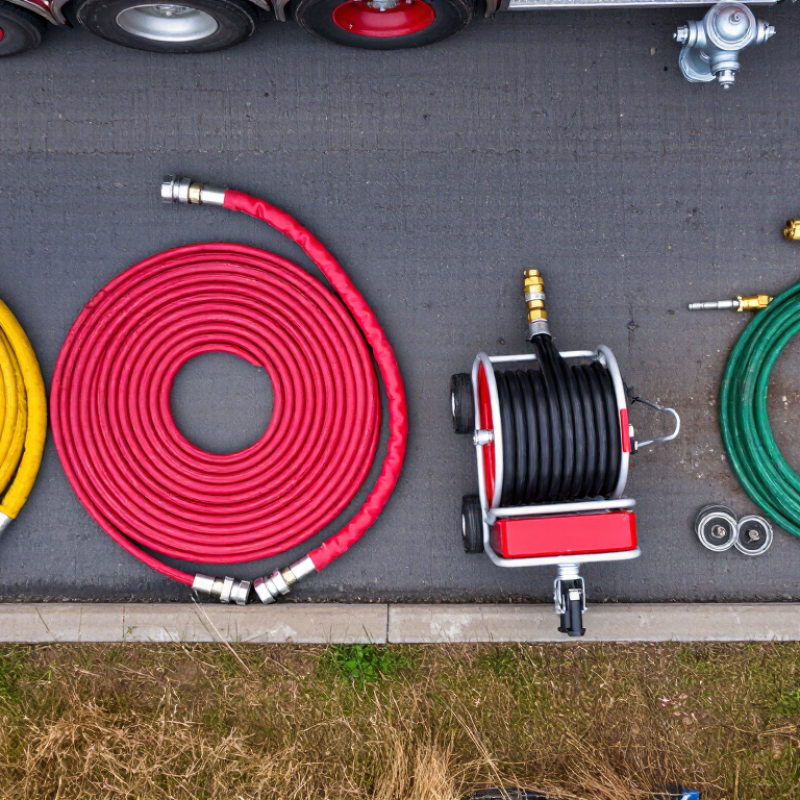
What Are the Top 4 Fire Hose Types in 2026?

Attack Hose: Typical 1.5–2.5 in. Diameters for Engineered Fire Streams

Attack hose carries water from an engine to the nozzle team, where stream control matters. Typical inside diameters range from 1.5 to 2.5 inches. A 1.5-inch line can be easier to move through a narrow hallway or around furniture. A 2.5-inch line can support greater flow, but its weight and reaction force can challenge crews. Bigger is not always better.

Fire-stream performance depends on more than diameter. Hose length, nozzle design, pump pressure, elevation, and friction loss all shape the water delivered at the tip. A long stretch around a building may behave differently from a short line across a driveway. Crews should use tested pump charts and local procedures, then confirm pressure and stream quality at the nozzle. Small differences matter. It is easy to focus on diameter and overlook the stretch.

These dimensions are typical, not a universal specification. Hose construction and approved operating limits vary, so check the hose markings and applicable guidance before deployment.

A practical detail is often overlooked: a charged line can feel far heavier than it did on the floor.

Supply Hose: Typical 3–6 in. Diameters for High-Volume Water Delivery

Supply Hose: Typical 3–6 in. Diameters for High-Volume Water Delivery

Supply hose moves large volumes of water between hydrants, pumps, and fireground operations. Common diameters range from 3 to 6 inches, with the right choice depending on the water source, pump capacity, and distance. A 5-inch line can deliver substantial flow, but it is heavier and takes more room to position than a smaller hose. Bigger is not automatically better.

On a paved street, a wide supply line may be laid along the curb to reduce kinks and keep access routes clear. Across uneven ground, crews may need extra care to protect the hose from sharp edges and vehicle traffic. Every connection matters. Couplings must fit securely, and the hose must be rated for the pressures expected in the operation. Diameter alone does not tell the whole story; length, bends, elevation, and pump performance affect usable flow.

A practical setup starts with checking the water source and estimating demand before choosing hose size. Then crews can plan the route and confirm that the pump and fittings are compatible. These details are easy to overlook when a scene is busy. They matter. A large line can still underperform if it is kinked, poorly connected, or supplied by an inadequate source. Hose condition matters, too: inspect for wear, leaks, and damaged couplings before use.

Wildland Hose: Typical 1–1.5 in. Diameters for Lightweight Field Operations

Wildland hose is designed for crews who carry, deploy, and reposition lines across rough terrain. Typical diameters range from 1 to 1.5 inches, balancing manageable weight with useful water flow. A 1-inch line can be easier to haul uphill or through brush, while a 1.5-inch line may support greater flow when the pump and water supply allow it. Smaller is not automatically better. Flow, pressure, and distance matter.

In the field, hose may cross ash, gravel, roots, and hot ground. Abrasion-resistant construction and secure couplings help, but they cannot prevent every failure. A pinched section can reduce flow; long runs can increase friction loss, especially with smaller diameters. Check the hose’s rated pressure and match it to the pump, fittings, and operating plan. Do not assume all 1-inch hose handles the same conditions. That assumption is easy to make. It is worth revisiting after each deployment. Before use, inspect for cuts, soft spots, damaged threads, and leaks, and follow local training and equipment guidance.

Wildland Fire Hose: Typical Diameter Range

A typical wildland hose diameter is 1–1.5 inches, balancing a lightweight field setup with water delivery needs.

The bar marks the stated typical range; specific hose selection depends on the operation and equipment.

Booster Hose: Typical 0.75–1 in. Diameters for Compact, Rapid-Deployment Lines

Booster hose is built for quick access, not for every fireground task. Common diameters range from 0.75 to 1 inch, making these lines compact enough to store on a reel and pull into position quickly. A short length can be useful for small, contained incidents where a larger line would be cumbersome. The hose may feel stiff when unrolled, especially in cold weather, so crews should practice handling the actual equipment they carry.

Diameter alone does not tell you how much water a line will deliver. Hose length, nozzle design, and operating pressure all matter. Check the hose’s rated pressure and the equipment manufacturer’s guidance before use; never assume two hoses of the same diameter perform alike. On scene, look for kinks, worn couplings, and damage near the reel connection. Small details matter. Booster lines can be convenient, and that convenience may tempt crews to use them beyond their intended role. They are not a substitute for selecting a line suited to the fire, available water supply, and crew training. A quick deployment is only useful when the line can support the task.

What Are the Top 4 Fire Hose Types in 2026? - Booster Hose: Typical 0.75–1 in. Diameters for Compact, Rapid-Deployment Lines
Hose Type Typical Diameter Common Construction Typical Use Deployment and Handling Key Consideration
Booster Hose 0.75–1 in. (19–25 mm) Usually a rubber-covered, reinforced hose designed to retain its shape under pressure. Vehicle-mounted reels for small exterior fires, mop-up, and other applications requiring a compact hose line. Often carried on a reel and can be deployed quickly by one operator. Its relatively small diameter limits flow compared with larger attack and supply hoses; suitability depends on the required flow and operating conditions.
Attack Hose Commonly 1.5–2.5 in. (38–64 mm) Typically a flexible, woven-jacket hose with an internal water-resistant lining. Handlines used by firefighters to deliver water or foam solution to a fire. Flexible enough to be carried, advanced, and positioned by crews, though larger diameters are heavier when charged. Hose diameter, length, nozzle, and available pump pressure all affect flow and handling.
Supply Hose Commonly 3–5 in. (76–127 mm); large-diameter supply hose is often 4–5 in. Usually a large-diameter, flexible hose intended to move substantial water volume between a water source, pump, or apparatus. Water supply from hydrants, portable tanks, or other sources to fire apparatus and pump operations. Usually laid along the ground; large-diameter sections can be bulky and are commonly handled by a crew or apparatus. Designed primarily for water delivery, not as a typical hand-held firefighting line.
Wildland / Forestry Hose Commonly 1–1.5 in. (25–38 mm), with sizes varying by task and local practice Lightweight, flexible hose, often with a woven jacket and lining; some configurations are designed for forestry use. Wildland fire attack, extended hose lays, and work in rough or vegetation-covered terrain. Light weight and flexibility aid carrying and movement over uneven ground; hose is often deployed in sections. Selection should account for terrain, abrasion exposure, water supply, and the applicable agency or service specifications.
Note: Diameter ranges are representative examples, not universal specifications. Available sizes, materials, pressure ratings, and approved uses vary by hose design and the requirements of the fire service using it.

FAQS

What is a typical diameter for a supply hose?

Supply hoses commonly range from 3 to 6 inches. The right size depends on the water source, pump capacity, and distance.

Is a 5-inch supply hose always the best choice?

No. It can deliver substantial flow, but it is heavier and takes more room to position. Bigger is not automatically better.

What can reduce flow through a supply hose?

Kinks, bends, long distances, elevation changes, and weak pump performance can all affect usable flow. A large hose can still underperform.

What should crews check before using a supply hose?

Inspect for wear, leaks, and damaged couplings. Confirm the fittings connect securely and the hose pressure rating suits the operation.

What diameters are typical for wildland hose?

Wildland hose commonly ranges from 1 to 1.5 inches. A 1-inch line is easier to carry uphill or through brush.

When might a 1.5-inch wildland hose be useful?

It may support greater flow when the pump and water supply allow it. The larger size is not automatically the better choice.

What can damage or restrict wildland hose in the field?

Ash, gravel, roots, and hot ground can wear the hose. Pinched sections and long runs may reduce flow.

Do all hoses with the same diameter perform alike?

No. Check the rated pressure and inspect for cuts, soft spots, damaged threads, and leaks. It is easy to assume otherwise.