Blog icon

Why Are Fire Hoses Essential for Industrial Safety?

Industrial safety depends on equipment that performs under pressure, heat, smoke, and human stress. Fire hoses are essential because they deliver large volumes of water directly to a developing fire. In a factory, a few seconds can protect production lines, electrical rooms, storage racks, and nearby workers. A properly selected hose also supports controlled cooling around tanks, machinery, and structural steel.

Fire-protection engineer Paul Grimwood has stated, “Firefighting is a balance between speed, safety, and control.” His observation explains why hose quality matters beyond simple water delivery. A hose must remain flexible when stretched across a concrete floor. Its couplings must connect securely. Its outer jacket must resist abrasion, heat, and repeated handling. Operators also need clear access, suitable nozzles, and regular inspection records.

Small details matter.

A cracked lining, hidden mildew, or poorly fitted coupling can delay response. Routine pressure testing can reveal weaknesses before an emergency exposes them. Training is equally important, because an excellent hose is useless when workers cannot deploy it confidently.

Still, fire hoses are not a complete safety strategy. That assumption deserves correction. Facilities need alarms, extinguishers, emergency planning, safe storage, and professional maintenance. They must also consider water supply limitations and the hazards of specific materials. A hose that works well near cardboard may not suit every industrial process.

Reliable fire hoses create a practical bridge between detection and control. Their value becomes clearest when a worker hears the alarm, sees smoke gathering near a machine, and reaches equipment designed to respond immediately. Safety is never perfect, but preparedness can be.
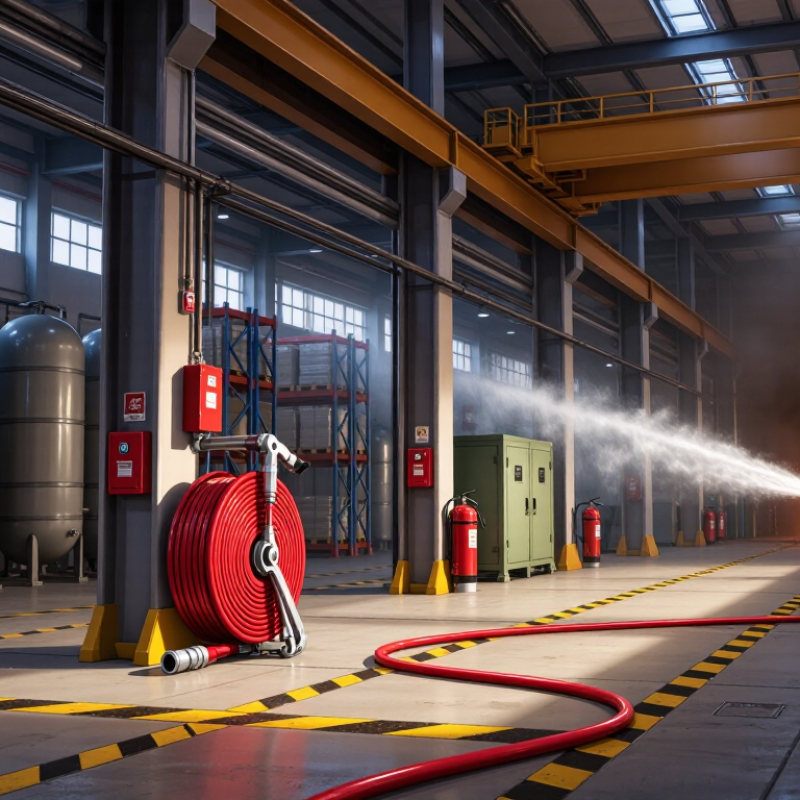
Why Are Fire Hoses Essential for Industrial Safety?

What Fire Hoses Are and How They Function

A fire hose is a flexible, pressure-rated pipeline for moving water or approved firefighting agents. It usually contains a woven outer jacket, a waterproof liner, couplings, and a nozzle. Water enters from a hydrant, pump, or fixed riser. Pump pressure pushes water through the liner. The nozzle converts pressure into a controllable stream, spray, or fog. Friction reduces pressure, especially across long runs or narrow diameters. That loss matters near hot machinery, where reach and cooling time affect evacuation. The NFPA report Fire Loss in the United States During 2023 recorded 1,388,500 fires and about 23.2 billion dollars in property damage.

Industrial hose systems must match the hazard, flow demand, and available water pressure. A large-diameter hose can deliver more water, but it becomes heavier and harder to position. During drills, crews should check coupling engagement, nozzle control, and safe hose routing. Inspectors should look for cuts, crushed sections, mildew, damaged threads, and flattened liners. A hose may look sound and still fail. That uncomfortable possibility deserves attention. NFPA 1960 provides recognized requirements for fixed firefighting equipment, including hose-related equipment and performance considerations.

Tips: Store hoses clean, dry, and away from sharp edges or chemical exposure. Record inspections and pressure tests. Replace uncertain equipment, not just visibly broken equipment. Practice with realistic heat, noise, gloves, and restricted visibility. Small details often expose weak procedures.

Why Are Fire Hoses Essential for Industrial Safety? — What Fire Hoses Are and How They Function
Fire Hose Type Primary Function Common Nominal Diameter Typical Construction Typical Operating Pressure How It Supports Industrial Safety
Attack Hose Delivers water or foam directly to a fire from a hydrant, standpipe, pump, or fire engine. Approximately 38–77 mm Flexible textile jacket with a rubber or thermoplastic lining. Commonly about 1.0–1.7 MPa, depending on the hose assembly and applicable standard. Allows trained personnel to control the direction, reach, and flow of extinguishing media during active firefighting.
Supply Hose Transfers large volumes of water from a hydrant, water source, or pump to the firefighting operation. Approximately 76–152 mm Large-diameter synthetic textile jacket with a durable internal lining. Often designed for operating pressures around 1.0–1.7 MPa, subject to the specific assembly rating. Reduces the time required to establish a reliable water supply for industrial fire protection systems.
Booster Hose Provides a compact, continuous water stream for small fires and rapid-response applications. Approximately 19–25 mm Usually a rubber or thermoplastic tube reinforced with textile or wire layers. Commonly rated around 1.0–2.1 MPa, depending on design and certification. Can be deployed quickly for incipient-stage fires before they spread to equipment, storage, or production areas.
Standpipe Hose Connects to fixed standpipe systems inside industrial buildings, warehouses, and high-rise facilities. Approximately 38–65 mm Flexible lined hose, frequently stored on a rack or in a cabinet with a nozzle. Must be compatible with the pressure of the building standpipe system; ratings commonly range from about 1.0–1.7 MPa. Provides accessible firefighting water on multiple floors or in remote areas of a facility.
Suction Hose Draws water from an open tank, reservoir, or other non-pressurized source into a fire pump. Approximately 65–152 mm Rigid or semi-rigid construction with reinforcement designed to resist collapse under suction. Rated primarily for vacuum or suction service rather than ordinary discharge pressure. Enables firefighting pumps to use alternative water sources when hydrant or municipal water supplies are unavailable.
Foam-Compatible Hose Conveys foam solution or compatible extinguishing agents to fires involving flammable liquids. Commonly 38–77 mm Chemically resistant lining selected for the intended foam concentrate and operating conditions. Must remain within the pressure rating specified for the hose, fittings, and foam system. Supports safer suppression of fuel, solvent, and other liquid-fuel fires where water alone may be ineffective.
Safety note: Dimensions and pressure values are typical industry ranges, not universal specifications. The correct hose must be selected, tested, stored, and maintained according to the applicable local fire code, installation standard, manufacturer instructions, and site hazard assessment.

Why Fire Hoses Matter in Industrial Fire Protection

Fire hoses matter in industrial fire protection because they deliver water quickly, directly, and continuously. On a plant floor, flames can spread across packaging, solvents, cables, or insulation within minutes. A correctly selected hose gives trained workers and emergency teams reach beyond a portable extinguisher’s limited discharge time. It also supports cooling, exposure protection, and access control during a developing incident.

The scale of fire losses explains this need. NFPA’s U.S. Fire Loss report recorded approximately 1,504,500 fires and 18.1 billion dollars in direct property damage during 2022. Industrial sites cannot treat hose systems as decorative equipment. Hose diameter, operating pressure, nozzle pattern, coupling condition, and water supply must match the hazard. NFPA 1962 also emphasizes inspection, care, and service testing for hose assemblies. A hose that looks clean may still contain aging damage.

Maintenance is where many facilities become less reliable. A reel blocked by pallets is useless. A folded hose with hidden cracking is worse. Inspection records should identify pressure tests, repairs, storage conditions, and training dates. Workers need realistic drills, not only classroom instructions. The International Association of Fire Chiefs has repeatedly emphasized coordinated response and practical preparedness in industrial emergencies. Even well-designed systems can fail through poor access or hesitation. That uncomfortable possibility deserves regular review.

Key Types of Fire Hoses Used in Industrial Facilities

Why Are Fire Hoses Essential for Industrial Safety?

Key Types of Fire Hoses Used in Industrial Facilities

Fire hoses give trained workers a direct way to control an early fire. Their value depends on correct selection, storage, and testing. A hose may appear ready while its lining has weakened. Small defects can become dangerous under pressure.

Hose reels commonly use semi-rigid hoses for quick response near work areas. They deliver water through a fixed nozzle and remain easy to handle. Attack hoses are flexible, layflat lines connected to hydrants or pumps. Their synthetic jackets resist abrasion across concrete floors. Suction hoses use rigid reinforcement to prevent collapse while drawing water from tanks or open sources. They are heavier and require careful coupling.

Facilities handling flammable liquids may need foam-compatible hoses. These hoses must suit the selected foam solution and operating pressure. Rubber-lined hoses can support repeated water use, but chemicals, heat, and sunlight still cause damage. Material compatibility matters.

During inspections, check couplings, gaskets, nozzles, and hose cabinets. Look for cuts, burns, mildew, crushed sections, and missing caps. Keep them visible. Do not store a hose with sharp bends or trapped moisture. Testing should follow the facility’s risk assessment, equipment instructions, and recognized safety requirements. Records should show dates, pressure results, repairs, and the person responsible. A common mistake is choosing a hose only by diameter. Flow rate, reach, temperature, connection type, and worker strength also matter. Details matter. Rechecking the layout after equipment changes is easy to overlook.

How to Select, Install, and Store Fire Hoses Safely

Why Are Fire Hoses Essential for Industrial Safety?

How to Select, Install, and Store Fire Hoses Safely

Fire hoses provide immediate water access when flames spread faster than emergency teams can arrive. NFPA reported 1,504,500 fires in the United States during 2022. Those incidents caused approximately $18.1 billion in property damage, showing why accessible equipment matters. Selection should match the facility’s water pressure, hose length, coupling type, nozzle pattern, and operating environment. Heat, oil, chemicals, and outdoor exposure can quickly weaken unsuitable materials.

Installation requires more than placing a hose inside a cabinet. Keep cabinets visible, unlocked when required, and free from pallets or machinery. Mount reels so workers can pull the hose without sharp bends. Check that connections fit tightly and that the nozzle opens smoothly. NFPA 1962 provides inspection and service-testing guidance, but site procedures must also follow local fire codes. Access matters.

Storage conditions affect reliability. Drain the hose completely after use, then dry it before rolling. Store it away from sunlight, freezing temperatures, corrosive vapors, and heavy objects. Keep it loosely coiled, without crushing the jacket or trapping moisture inside. Keep it dry.

A practical inspection should look for cuts, abrasion, mildew, damaged couplings, and flattened sections. Pressure testing must follow the applicable standard and the hose manufacturer’s instructions. A hose may look acceptable yet fail under pressure. That uncomfortable possibility deserves attention. NFPA’s fire-loss data is a reminder that small maintenance gaps can become expensive, dangerous failures.

Why Are Fire Hoses Essential for Industrial Safety?

How to Select, Install, and Store Fire Hoses Safely

How to use this chart: Larger-diameter hoses hold more water over the same length, which can support higher flow demands but may increase weight and handling difficulty. Select hose diameter, length, pressure rating, couplings, and nozzle type according to the hazard, water supply, applicable fire code, and site risk assessment.
Install safely
Use compatible couplings, protect hoses from sharp edges and vehicle traffic, and keep access routes and hose cabinets unobstructed.
Store correctly
Keep hoses clean, dry, drained, ventilated, and protected from heat, sunlight, chemicals, rodents, and crushing loads.
Inspect regularly
Check for cuts, abrasion, mildew, damaged couplings, leakage, and degraded linings. Follow NFPA 1962 or the applicable local inspection and testing requirements.

Approximate water volume is calculated from V = πd²L/4 for a 30 m hose, treating the nominal diameter as the internal diameter. Actual capacity varies with hose construction and internal dimensions.

Fire Hose Inspection, Maintenance, and Emergency Use

Fire hoses are vital industrial safety equipment, but their value depends on readiness. A neglected hose may crack, leak, or fail under pressure during an emergency. Inspect the jacket for cuts, burns, mildew, and flattened sections. Check couplings, gaskets, valves, nozzles, and cabinet doors carefully. Record each inspection with the date, location, and observed condition.

Tips: Keep hose cabinets accessible and clearly marked. Never store tools or materials in front of them. Confirm that the hose is dry before storage. Replace damaged parts through qualified personnel. Follow site procedures, manufacturer guidance, and applicable safety standards.

During an emergency, raise the alarm and contact emergency responders. Only trained workers should operate a fire hose. Remove the nozzle carefully, maintain a firm stance, and keep both hands on the line. Open the valve slowly to control sudden pressure. Avoid sharp bends and never direct water toward energized electrical equipment unless approved for that hazard. A hose can become heavy and difficult to control quickly. Team support may be necessary. After use, isolate the supply, drain the hose, and arrange professional inspection before returning it to service. I have seen rushed checks overlook small coupling damage. That detail can matter.