How to Choose the Best Fire Hose Manufacturers in 2026?
Choosing among fire hose manufacturers in 2026 requires more than comparing prices, colors, or delivery promises. A hose may look strong on a warehouse floor, yet fail after repeated dragging across concrete. The better question is simple: can this manufacturer prove dependable performance under pressure, heat, abrasion, and storage?
Fire protection engineer and author Paul Grimwood has said, “Firefighting is a science, not an art.” That principle should guide every purchasing decision. Reliable fire hose manufacturers explain their testing methods clearly. They provide traceable material records, pressure-test results, coupling specifications, and production controls. Look for evidence covering burst pressure, flexibility, abrasion resistance, chemical exposure, and long-term aging. Ask how each hose performs after repeated folding and deployment. Request samples, not only brochures.
Experience matters. A manufacturer serving municipal brigades may understand rapid deployment, while an industrial supplier may focus on chemical resistance and harsh environments. Neither option is automatically better. The correct choice depends on your water system, nozzle pressure, climate, storage space, and response procedures.
Small details reveal professionalism. Inspect stitching, lining smoothness, coupling threads, labeling, and packaging. Check whether technical staff answer specific questions without evasion. Confirm independent certification and compliance with the standards required in your region.
No checklist is perfect. I would still visit the factory when the purchase is large. A polished website can hide inconsistent production. A modest supplier may offer excellent workmanship, but weak documentation remains a serious concern. This guide will compare quality, testing, customization, service, and total ownership cost, helping buyers choose with evidence rather than confidence alone.
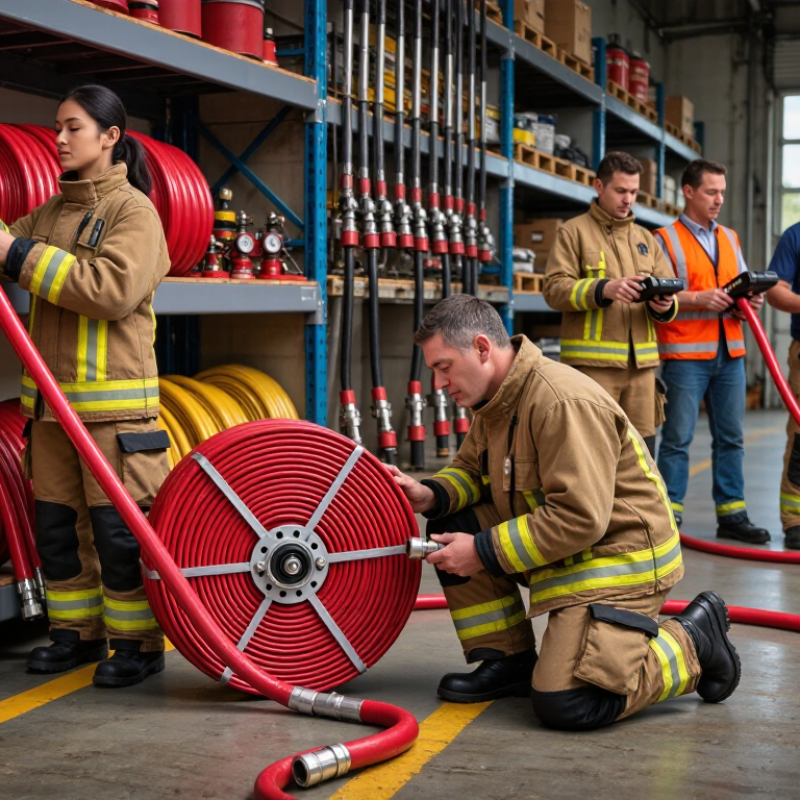
What Defines a Reliable Fire Hose Manufacturer in 2026?
A reliable fire hose manufacturer in 2026 must prove performance beyond a polished catalog.
NFPA’s Fire Loss in the United States During 2023 reported more than 1.3 million fires and billions of dollars in direct property damage. That pressure makes material consistency essential. Buyers should request test records for burst pressure, abrasion resistance, heat exposure, and coupling strength. The results should identify production batches, test dates, and laboratory methods. Vague claims are not enough.
Look for manufacturers that follow current NFPA 1960 requirements and maintain documented quality systems, such as ISO 9001-based controls. A dependable factory checks jacket weaving, tube adhesion, and fitting torque during production. It also provides clear storage guidance and replacement criteria. The 2024 NFPA Fire Protection Handbook stresses inspection, maintenance, and correct hose handling. A manufacturer should support those tasks with training and responsive technical service. Ask how failed samples are investigated. Ask again.
Traceability matters during an emergency.
Each hose should carry readable identification, while digital records should connect it to materials, inspections, and shipment details. Field experience deserves attention too. A hose may pass a laboratory test yet fail after repeated dragging over rough concrete. No manufacturer is flawless. However, reliable suppliers disclose limitations, accept field feedback, and improve designs through verified corrective action. That honesty often reveals more than a perfect sales presentation.
Which Fire Hose Standards and Certifications Should You Verify?
Choosing the best fire hose manufacturer in 2026 requires more than comparing prices or delivery times. Verify which standards apply to the exact hose type, diameter, lining, and intended use. A supplier should identify the current edition of each standard, not simply print a familiar number on a brochure. For delivery hoses, check relevant national or regional requirements, such as EN, BS, NFPA, or equivalent specifications. Suction hoses may require different testing under standards for suction hose assemblies.
Ask for complete test reports from an independent laboratory. These reports should cover working pressure, hydrostatic pressure, burst pressure, abrasion, kinking, temperature resistance, and coupling retention. The test sample must match the production hose. A report for a 65 mm hose cannot automatically validate a 25 mm model. Small detail. It matters.
Confirm whether the product has recognized third-party certification or listing for its intended fire-service application. Also inspect the certification scope, certificate number, validity date, factory location, and listed hose construction. ISO 9001 can indicate a controlled quality system, but it does not prove that a specific hose meets fire-performance requirements. Request batch traceability, inspection records, and samples with permanent markings. The markings should show size, pressure rating, standard reference, and production information.
I would not trust a certificate PDF alone. Contact the issuing body when records look incomplete or unusually generic. In practice, manufacturers may provide strong documents yet overlook field conditions, such as sharp concrete edges or repeated wet storage. That is where careful evaluation becomes imperfect, but necessary.
How to Choose the Best Fire Hose Manufacturers in 2026?
Which Fire Hose Standards and Certifications Should You Verify?
The chart ranks commonly referenced fire hose standards and approval schemes by practical verification priority when evaluating a supplier. The score is an editorial checklist score from 1 to 5, not a certification result or a performance guarantee.
Always confirm the applicable edition, product scope, test reports, traceability documents, and certification status with the relevant standards organization or approval body. Requirements vary according to hose type, installation, pressure rating, and target market.
How to Compare Materials, Designs, and Manufacturing Capabilities
Choosing a fire hose manufacturer in 2026 requires more than comparing prices. Start with the hose’s working environment. Nitrile linings usually resist oil and abrasion well, while EPDM handles heat and weather more effectively. Polyester jackets are lightweight, but thicker woven structures may survive dragging across concrete better. Ask for burst-pressure results, abrasion testing, bend-radius data, and coupling retention records. A glossy jacket proves little.
Manufacturing control matters just as much. Look for controlled extrusion, consistent wall thickness, traceable raw materials, and pressure testing on every production batch. Current NFPA fire-hose requirements emphasize performance, construction, and testing, not attractive catalog claims. NFPA’s U.S. Fire Loss report recorded about 1,388,500 fires and 29.6 billion dollars in direct property damage during 2023. That figure shows why small quality variations deserve serious attention. I would not accept a certificate without checking its test date and scope.
Tips: Request samples from different production lots. Compare coupling alignment, seam uniformity, and flexibility at low temperatures. Ask how rejected hoses are recorded. A manufacturer that cannot explain failure analysis may be hiding weak controls. ISO 9001 certification can support traceability, but it does not replace hose-specific testing. In my experience, buyers sometimes overvalue tensile strength. Field handling, storage, and maintenance can matter more. A stronger hose can still fail early when folded wet or dragged over sharp edges.
How to Evaluate Quality Control, Testing, and Product Traceability
Choosing the best fire hose manufacturer in 2026 requires more than comparing prices. NFPA’s Fire Loss in the United States During 2023 reported 1,388,500 fires and about $22.2 billion in direct property damage. A failed hose can worsen an already dangerous scene. Ask for controlled test records, not only product brochures. Testing should cover pressure, burst strength, abrasion, kinking, leakage, and coupling performance. Records should identify the test method, equipment, operator, date, and result. NFPA 1961 provides a useful reference for fire hose performance and manufacturing expectations.
Tips: Request samples from regular production, not special inspection batches. Check whether serial numbers link each hose to raw materials, inspection results, and shipment records. ISO 9001:2015, especially clause 8.5.2, supports clear product identification and traceability. A supplier should explain its process without hesitation.
Do not accept one certificate as complete proof. A certificate may confirm compliance, but it may not reveal inconsistent rubber compounds or weak stitching. Review calibration certificates for pressure equipment. Confirm that failed samples trigger documented corrective actions. Traceability should work both ways: from a finished hose back to its materials, and from a material lot forward to every affected shipment. No audit is perfect. Sampling can miss a weak batch. That is why independent testing and periodic factory reviews remain valuable. A polished factory tour is not evidence by itself. Ask difficult questions, and record the answers.
How to Assess Pricing, Support, Delivery, and Long-Term Value
How to Choose the Best Fire Hose Manufacturers in 2026?
Price should be measured beyond the purchase order. Compare hose cost, fittings, testing, freight, replacement cycles, and downtime. A cheaper hose may become expensive after repeated failures.
NFPA’s Fire Loss in the United States During 2023 report recorded 1,388,500 fires nationwide. That scale makes dependable equipment a practical risk-control decision, not merely a purchasing preference.
Ask manufacturers for documented test procedures, batch traceability, and certificates aligned with NFPA 1961 or applicable local standards. Review warranty exclusions carefully. Support quality matters during inspections, training, and emergency replacement. Request a named technical contact, response targets, and spare-parts availability. Delivery should be assessed with evidence, including average lead time, on-time delivery rate, and contingency stock. A confident promise is not enough.
Tips: Build a weighted scorecard. Give separate scores for landed price, test evidence, support, delivery, and expected service life. Require sample documentation before approval. Check references from facilities with similar pressure, climate, and usage. Do not ignore storage conditions; sunlight, moisture, and poor coiling can shorten hose life. In practice, some buyers overvalue the lowest quotation. I might, too, without a disciplined review. No scorecard is perfect. Recheck assumptions after the first inspection cycle, and compare actual maintenance records against the manufacturer’s projected lifespan. Reliable suppliers should accept that scrutiny.